Iamai: A Journey into the Unseen
A Metaphysics Textbook for non mystics
About


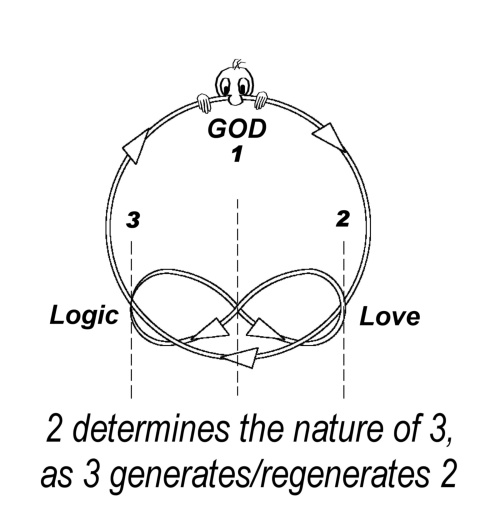
3 in1in 3 illustration
           Basic physics is relevant in our daily lives.  For instance, we use the recognized laws of motion, thermodynamics, gravity, etc., just to walk, talk, and to keep warm.
           Likewise, the basic metaphysical mechanics in Iamai are applicable daily.  This book uses the science class format to teach metaphysical science principles.  It provides a universal model, labs, homework assignments, and questions at the end of each chapter. 
           Iamai's paradigm, 'hands on' labs, and homework assignments exposes a you to some basic fundamental metaphysical principles behind all things.
 
     Iamai presents a metaphysical and physical overview of God manifesting into physical form.  (The title reflects this.  I Am, the name the Nameless God gave to Moses on the mountain relating to an I, a human ego.) Iamai does this through unifying or using inclusive ideas, definitions, or new terms. 


          Since Truth is Eternally constant, there is nothing new in Iamai.  Even using mathematical reasoning metaphysically is not new.  The idea is older than Pythagoras. 
           It is the presentation of the metaphysical subject matter as a western science class that makes Iamai relatively different.  A summary of Iamai: A Journey into the Unseen follows:


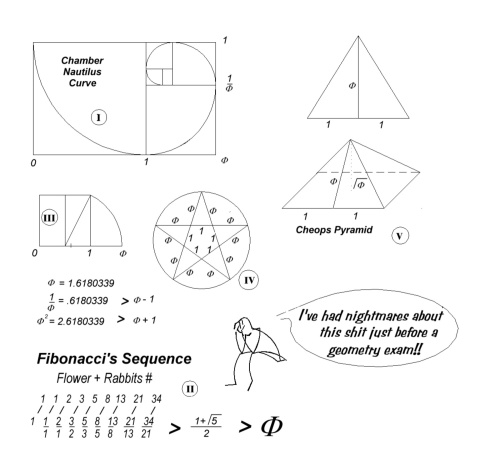
           The first chapter of Iamai is an overview.  It shows that the idea of the use of mathematical logic and mysticism is not new.  It does this by introducing the reader to the roots of western sacred geometry, Pythagoras and the Pythagorean mystery schools, plus the two mathematical proportions of pi and the golden section. 
 
Figure 1-4 The Golden Section
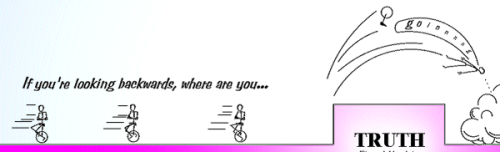
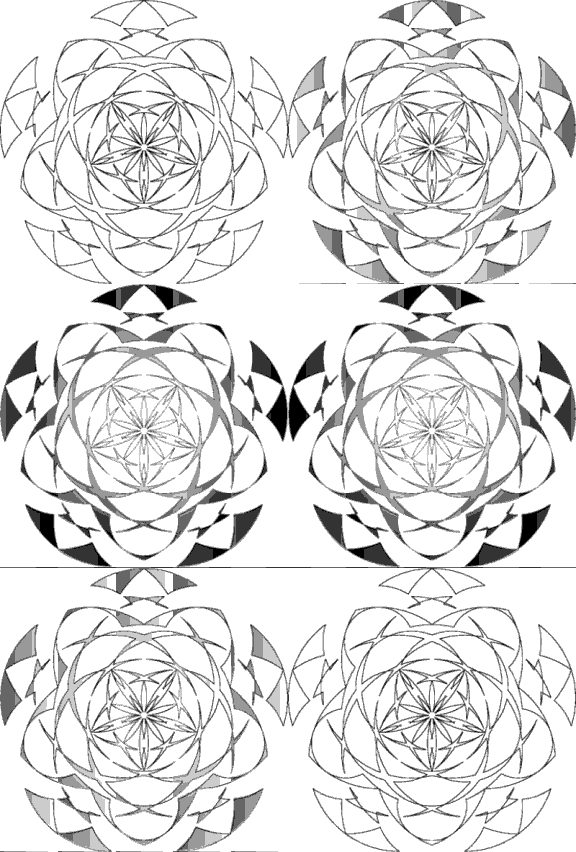
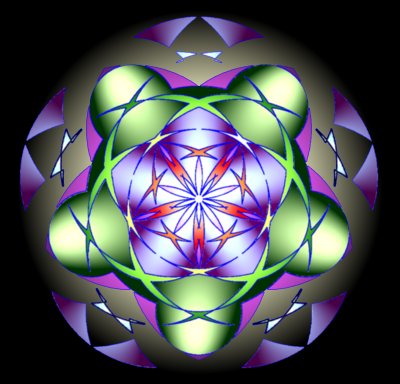
            There are a number of assignments or exercise presented in this chapter.  The first lab and homework assignment is truth recognition, for you to see the effect truth has on your mind.  The second homework assignment is about keeping silent with a number of rationale for this, and the third is to make your own mandala.  (Mandalas are to be made in preparation for some exercises presented in Chapter 6.)


          In the second chapter, Iamai generates a skeleton of a thought construct going from the 'top' down, from God to physical form.  The chapter begins with an introduction to the roots of mathematics. 
          Iamai then gives language terms precise meaning, treats these terms as if they were mathematical expressions, and assembles them into a set of postulates and theorems.  It presents 7 postulates and 67 Theorems.  It introduces ancient reoccurring mystical and spiritual concepts using a math logic format.


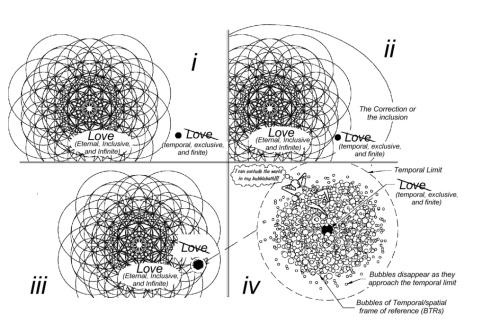
Figure 3-4 The Mirror
            The thought construct of Chapter 2, plus implications, is continued in Chapter 3.  The provided skeleton is 'fleshed' out; it is given a physical body
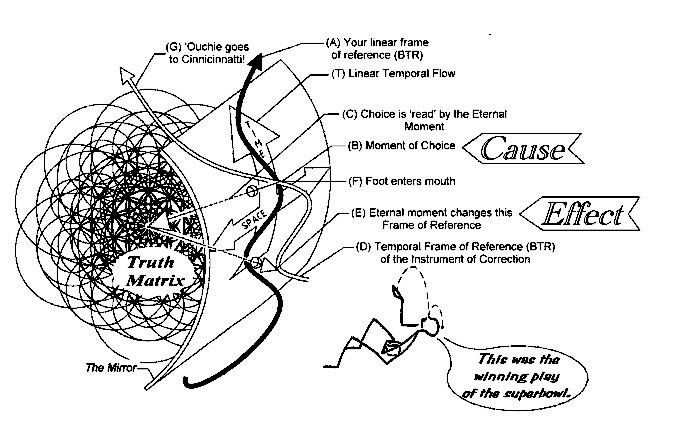
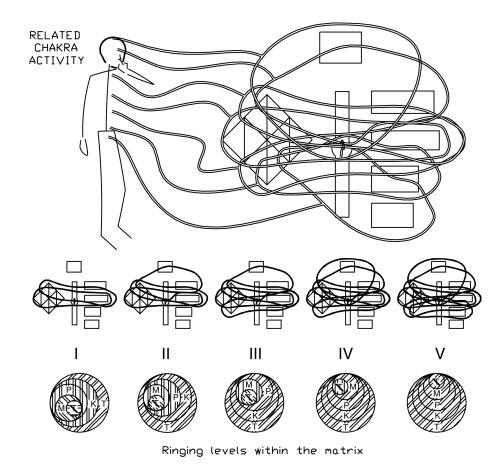
            This chapter continues the theme of going from the 'top' down.  In this chapter, physics and metaphysics theories are united with the introduction of the concepts involving correction of untruth, the Mirror, Bubbles of Temporal/spatial Reference (BTRs), and their consequent matrices of interactions. 
            This chapter incorporates the current physical science's paradigm and integrates it into second chapter concepts. 
            Mid chapter, a long-term exercise or homework assignment is presented. This assignment involves truth perception by mentally jumping parallels.  A truth a day from something around you for an extended period.
            At the end of Chapter 3, the concepts involving Eternal-temporal interface mechanics (specifically time folding) are introduced.


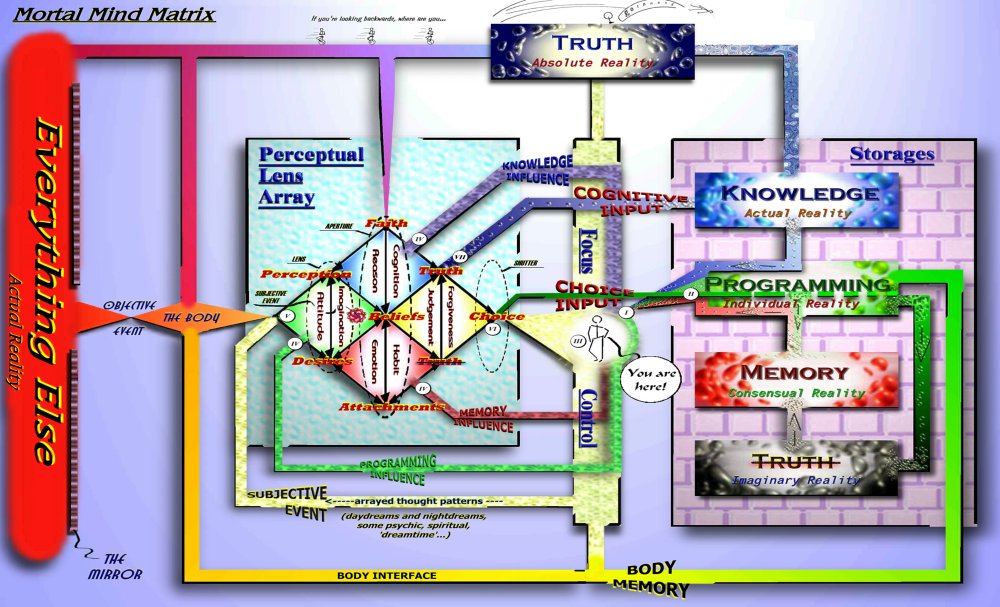
      Chapter 4 concludes the thought construct started in Chapter 2.  It gives the skeleton and body a mortal mind.  It examines in detail how truth and untruth exists in the human thought matrix/mind. Iamai discusses the realities involved, the limits of perception, and the predominant elements of the human BTR's matrix and perceptual lens array (Perceptions, Desires, Faith, Belief, Attachments, Truth, Untruth, and Choice). 
 
            It discusses storages (Truth, Knowledge, Programming, Memory, and Untruth), focuses control, and presents a breakdown of interactions of these elements within the human mind/matrix. 
            Comparisons are made between the human matrix's operation and a camera or our eye.  Within this chapter, there are time and space perceptional exercises and personal labs using the imagination to expand the 'mind's eye'.
 
Figure 4-3 Human Matrix Storages


           The remainder of Iamai looks at various manipulations of the presented human matrix/mind model.  Chapters 4, 5, and 6 introduce elementary operations of the human matrix.  Chapters 7 and 8 introduce intermediary operations of our mind/matrix.  Chapters 9 and 10 cover intermediary to advance usage of our mortal mind.
 
 
Figure 5-2 Formula Assembly
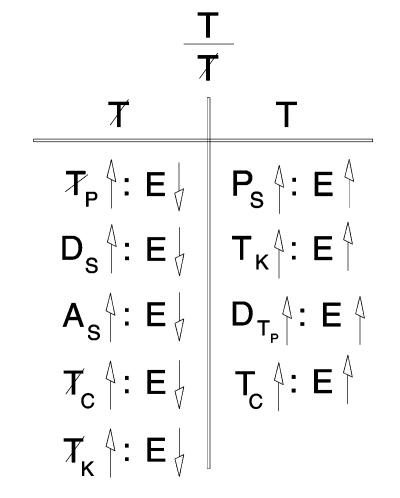
          Specifically, Chapter 5 takes the components of the human mind/matrix, treats them as numerical values, and produces a general formula of effectiveness for all human situations. 
          This chapter familiarizes you with the front end of your mind (the perception/desire lens) by an experiment or homework assignment.


     Chapter 6 entails a variety of exercises, labs, and meditations, both traditional and non-traditional.  A short list includes: breathing, chanting (and their basic categories), empty mind exercises with and without an external focus (mandalas), and several ways mentation can be used to get out of mentation. 
          Each exercise is related back to the human matrix and its elements -- Chapter 4.


           Once a person has been doing still mind exercises for a period of time, psychic phenomena (ESP) becomes a side effect.  This is the realm of Chapter 7.  This chapter simplifies things by defining all psychic phenomena as communication within One Mind.  We perceive these psychic forms as telepathy - either Mind/mind or mind/mind. 
           The chapter gives brief definitions of some of the major manifestations of ESP and the routes taken through the human mind/matrix model presented in Chapter 4.  Relating information given in Chapters 4, 5, and 6, it introduces the reader to a number of exercises that can help cultivate psychic informational flow through their mortal mind.


          Chapter 8 is an extension to Chapter 6.  It touches on tool usage and expands on empty mind exercises. 
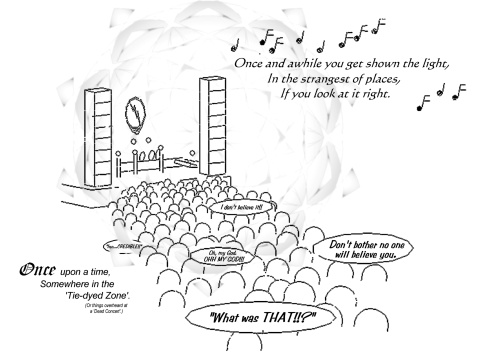
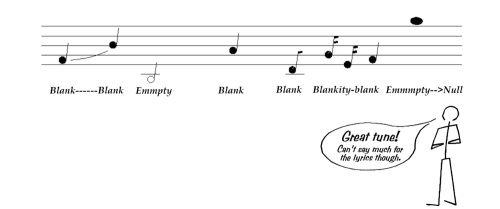
           This chapter discusses the use of music (and its mechanics) to facilitate a change of consciousness, and gives labs or homework assignments, to illustrate this. 
 
 
           This chapter also shows how empty mind exercises are easier, if done in short bursts of blankness. 


            All the information of the previous chapters is pulled together in the ninth chapter, Concerning Magic.  
 
            It defines the five kinds of magic (Black, White, Gray, Silver, and Gold), plus the four rules concerning the learning and use of magic.
          • To Know
          • To Dare
          • To Will
          • To Keep Silent
 
Manifestation


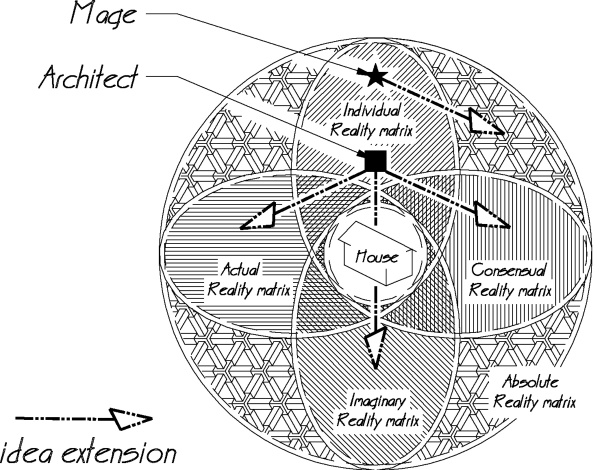
            Chapter 9 discusses the Eternal to temporal mechanics (Chapters 2 - 4) of magic.  It relates the human matrix (Chapters 4 and 5) to Truth Matrix mechanics (Chapters 2, 3, and 7).  The chapter presents patterns and parallels (it parallels the magical operation to an architect building a house), and relates the magical operation back to the formula of effectiveness (Chapter 5). 
           This chapter is the springboard to the last chapter.


           In Chapter 10, the concept of Gold magic is extended into miracles.  The chapter gives a short synopsis of world religions and the concepts they have in common. 
           Iamai finishes by taking the introduction and the first chapter of A Course in Miracles(C) (The Principal of Miracles) and cross-references the ACIM material to the material in Iamai: A Journey into the Unseen's previous chapters.1


About the Author

          The author is a bipedal quadruped located on the third predominately electro-magnetic/gravitational event -- planet -- gravitationally affected by a larger predominately nuclear/gravitational event -- star.  This nuclear event is one of a large multitude of nuclear events that is locally known as the Milky Way.
          The biped's 'planet' is inhabited by a large number of bipeds in mostly localized consensual reality groups. These bipeds have basically two physical sex groups and the author biped belongs to the group called 'male'. 
          As a group, these bipeds are  relatively intelligent and  a relatively recent development on this planet.  Consequently, the planet's bipeds' group awareness (as well as its mental-emotional maturity) is that of adolescence.
          Before the author biped reached full maturity, it turned from disassembling toys as a curiosity and turned to disassembling itself.  Specifically, disassembling its mind. 
          Some of the biped's research, experiences, experiments, and their results are assembled into a manual entitled Iamai. What  has been put together is a 'book', the biped wished existed, when it first started its 'quest' -- experimenting in its head.


Manifestation


Home Purpose Contents email
Reading Room  Order  Free Energy
1)Portions from A Course in Miracle(C) copyright 1975, 1992, 1999 reprinted by permission of the Foundation for A Course in Miracle - 1275 Tennanah Lake Road – Roscoe, NY 12776-5905
The ideas represented herein are the personal interpretation of the author and are not necessarily endorsed by the copyright holder of A Course in Miracle(c).